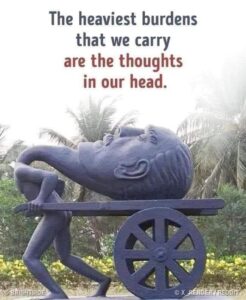
The pain of losing my brother was, in some sense, inevitable. I could, perhaps, choose thoughts that made it go away. But, in a larger sense, I would not have wanted it to go away too soon. As President Nelson said, "The only way to take sorrow out of death is to take love out of life." Who wants to do that? So, we can choose pain when it serves us. I think it serves us to grieve after the death of a loved one. However, the thoughts that I would never feel so sunny or hopeful again did not serve me. Any sense that he was "too young to die" was a judgment about how something went wrong, the cosmos was out of balance, and I was suffering because if it.
It wasn't supposed to be this way.
Taken together, in some sense, these thoughts all add up to the idea that, "it wasn't supposed to be this way." And that judgment, in all of its forms, will keep us in pain as long as we carry it. It is one thing to feel the pain of loss when your marriage ends. It is quite another to burden those thoughts further with a lot of judgments about things you cannot control. I hope this gives another level of meaning to the truth that, "with what judgment ye judge ye shall be judged." (Matthew 7:2.) This is certainly the truth. Our judgments of our own situation -- about how something is out of place or wrong -- are guaranteed to keep us in pain far longer than if we just allowed ourselves to experience the authentic pain of loss, unladen with the idea that it was supposed to be some other way.
Can you see how this list of thoughts is elevating, where the former list is heavy and overwhelming? Both lists are thoughts about the same situation, but they are different interpretations. Consider what the Prophet Joseph Smith taught:
Truth is what IS, not what we think should be. It is not the judgments we make about what might be superior or preferable. How we think about our circumstances will determine whether we are happy or miserable. Joseph further taught:
How do we receive any truth? It is through our "agency." We may have physical ordinances like baptism, but they mean nothing if they do not reflect an exercise of "agency," where we receive that truth in our thoughts. Think of that metaphor of light and darkness. "That which is of God is light." (D&C 50:24.) Moses saw the difference between the glory of God and the glory of Satan, and told Satan that his glory "is darkness unto me." (Moses 1:15.)
My plea to you is not to think your way out of all pain. Pain is part of the human experience and sometimes gives meaning to the love we feel. The point is really to keep it in its proper place. Make it authentic pain, and not the result of the judgments we make about something being wrong or out of place. Pain with all sorts of judgments hanging on it will last longer and hurt more deeply and get us stuck and unable to move forward. So my plea is to embrace the light with your thoughts. We have all kinds of thoughts. Not all of them reflect light and truth. Many of them are laden with judgment. Choose to keep the thoughts that are elevating and invite more love into your life and into your heart. That is the way of happiness.
